
10 Common Small Business Marketing Mistakes (and How to Avoid Them)


Let's start with some real talk: if your marketing feels like it's not working, it's probably not you. It's one (or six) of the mistakes on this list.
Here's the thing nobody tells you when you start a business: over half of small businesses are running their entire marketing on less than $1,000 a month, and half don't have anyone dedicated to it at all. It's usually you, or your VA person, squeezing it in between everything else. So when I say "mistake," I don't mean you're bad at this. I mean, marketing has a way of punishing anything done on the margins, and most small businesses are doing it on the margins.
Half of small businesses have no one dedicated to marketing, and over half run on less than $1,000 a month. If your marketing feels scattered, that's why. It's not a talent problem. It's a bandwidth problem.
The good news: almost none of these mistakes require more money to fix. They require a few honest decisions. Let's go through them.
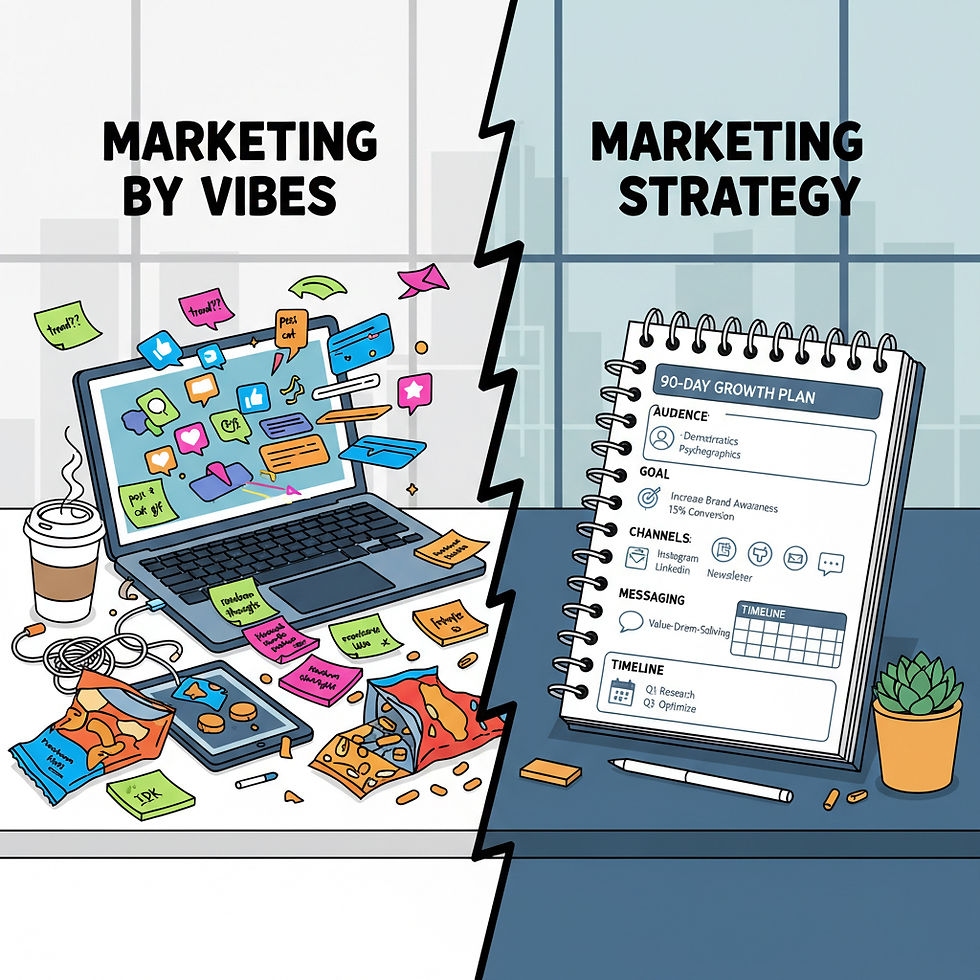
1. You don't have a strategy… you have vibes
If your marketing plan lives entirely in your head and changes based on what you feel like posting on a given Tuesday, that's not a strategy. That's improv.
A real strategy answers three questions before you post a single thing: who are you talking to, what do you want them to do, and how will you know if it worked? If you can't answer those in one sentence each, you're not behind on execution. You're missing the plan execution is supposed to follow.
Fix it: Write down your audience, goal, and success metric for the next 90 days. One page. That's it. That page will save you more time than any app or tool you could buy.
2. Trying to be everywhere instead of where it counts
I get it. Every platform feels mandatory. TikTok, Instagram, LinkedIn, a newsletter, maybe Pinterest because someone told you it converts. So you spread yourself across five channels and do all of them at 20%.
Your customers are not on every platform. They're concentrated on two, maybe three. Everywhere marketing isn't ambitious; it's exhausting, and it usually means your best channel is getting your worst effort.
Fix it: Pick the two platforms where your actual customers spend time, and go deep. Cutting a channel is a strategy decision, not a failure.
3. Talking to "everyone" (which means talking to no one)
"Small businesses" or "people who need help" is not an audience. It's a category. Copy written for everyone reads like it was written for no one, because specificity is what makes someone stop scrolling and think, wait, that's me.
Fix it: Get specific enough that some people feel like your content isn't for them. If your message could apply to any business in any industry, it's too broad to convert.
4. Branding that changes depending on who's posting
Different fonts on the website versus Instagram. A logo that's slightly off-color depending on the file someone grabbed. A tone that's professional in emails and unhinged on TikTok with no bridge between the two. Individually, small. Together, it tells people you're not quite buttoned up, and trust is the whole game in marketing.
Fix it: Build a one-page brand sheet: colors, fonts, logo files, and three words that describe your voice. Require everyone who touches your marketing to use it. Boring? Yes. Effective? Also yes.
5. Posting content with no job to do
Every post, email, and ad should have exactly one job: get a click, start a conversation, build trust, or drive a sale. "Just posting to stay active" isn't a job. It's activity that feels like progress without producing any.
Fix it: Before you hit publish, finish this sentence: "After seeing this, I want the reader to ___." If you can't fill it in, don't post it yet.
6. Ignoring the data you already have
Most small businesses have more data than they think: website analytics, email open rates, which posts got saves versus which got crickets. And they never look at it. Then they wonder why they keep making the same content that doesn't work.
Fix it: Once a month, spend 20 minutes reviewing what actually performed. Do more of that. Stop doing the thing that consistently flops, even if you love it.
7. One-and-done campaigns with no follow-up
You run a promo, a launch, a big push, and then it's over—no nurture sequence, no retargeting, no follow-up email to the people who almost bought. Most of your revenue is hiding in the "almost" pile, and one-and-done marketing leaves it there.
Fix it: Every campaign needs a second touch built in: a follow-up email, a retargeting ad, something. The first message rarely closes the deal. The follow-up usually does.

8. Betting everything on organic reach
Relying entirely on organic posting means you're fully at the mercy of an algorithm you don't control and can't predict. When it changes (and it will), your visibility can drop overnight through no fault of your own.
Fix it: You don't need a massive ad budget. Even a small, consistent paid spend behind your best-performing organic content gives you a floor that doesn't depend on an algorithm's mood.
9. Copying competitors instead of building your own voice
Watching what's working for competitors is smart research. Copying their content, their offers, and their tone word-for-word is how you become the forgettable version of someone else. Customers can't choose you for a reason if you don't have one.
Fix it: Use competitor research to find gaps, not templates. What are they NOT saying that your audience needs to hear?
10. Not tracking ROI, so you can't tell what's actually working
This is the big one, and it's the one that makes every other mistake harder to catch. If you don't know which channel, post, or campaign actually drove a sale, you're making every future decision on a guess instead of a fact.
Fix it: Pick one number that matters most to your business right now (leads, bookings, revenue, whatever it is) and trace it back to its source every month. You don't need fancy dashboards. You need one number, tracked consistently.

The pattern behind all ten
Look back at this list, and you'll notice something: none of these are talent problems. They're all attention problems: decisions that never got made because marketing kept getting squeezed into whatever time was left over.
That's not a you problem. That's a bandwidth problem, and it's exactly what I look for when I audit a business's marketing.
Want to know which of these are quietly costing you customers? Grab a free Marketing Audit, and I'll tell you- no fluff, no sales pitch dressed up as a "consultation." Just a clear look at what's working, what's not, and what to fix first.

FAQ
What is the most common marketing mistake small businesses make?
Not having a documented strategy. Most small businesses run on instinct instead of a plan, which gives every other mistake on this list, from an unclear audience to inconsistent branding, room to grow unchecked.
How can a small business improve its marketing without spending more money?
Fix decisions, not budgets. Writing down your audience and goals, tightening your branding, and tracking one key number each month cost nothing and address most of the mistakes above.
How often should a small business review its marketing strategy?
At minimum, once a quarter. Monthly is better if you're actively running campaigns, since it lets you catch what's working (or not) before too much time or budget is wasted.
What's the difference between a marketing mistake and a marketing experiment?
A mistake repeats without anyone noticing it isn't working. An experiment has a defined goal and a review date. Without tracking results, every "experiment" quietly turns into a mistake.


Comments